
Pakistan sits in a strange tug-of-war with plastic. Letting go of plastic consumption entirely isn’t realistic right now, but reducing it in a smart, structured way absolutely is. The country relies heavily on cheap packaging, weak enforcement, and an informal recycling economy that picks up the slack where policy fails. Plastic is everywhere because it’s convenient, durable, and—most importantly—cheap for both businesses and consumers.
The trouble is that convenience has turned into dependence. Single-use bags, sachets, cups, and bottles have become woven into daily life. Any attempt to ban them overnight usually collapses because alternatives aren’t affordable, supply chains aren’t ready, and enforcement is uneven. The result is a familiar cycle: big announcements, momentary compliance, then business as usual.
Still, Pakistan has the ingredients to change course. Modern recycling technologies, rising awareness, new provincial bans, and ESG pressure on large industries are pushing things in the right direction. Companies like yours that are building recovery systems, material recovery facilities, and plastic-to-product solutions are exactly what a transition requires.
The real question isn’t whether Pakistan can get rid of plastic entirely, but whether it can redesign how plastic is used so it doesn’t end up in rivers, drains, and landfills. Reducing consumption, improving collection, scaling recycling, and promoting alternatives would move the country toward a future where plastic remains in the economy instead of leaking into the environment.
Key Facts About Industrial Plastic Consumption in Pakistan
There is regulatory pressure: Pakistan recently introduced regulations that mandate at least 50% recycled content in plastic bottles starting July 1, 2028. INP
Packaging Dominance in Industry
Over 50% of plastic used in Pakistan is consumed by the packaging industry (FMCG packaging, plastic bags, beverage bottles, etc.). CDPR
This includes plastic used for food and drink containers, shopping bags, and consumer goods. CDPR
Production Capacity & Scale
Pakistan’s plastic industry has over 11,000 manufacturing units (small, medium, large) operating to meet both domestic demand and exports. INP
According to plastic manufacturing associations, plastic contributes significantly to GDP via local production. INP
Raw Materials Dependency
The raw materials for the Pakistani plastic sector (like PET, PE resins) are largely derived from petroleum / petrochemicals. UN Trade and Development (UNCTAD)+1
Much of the plastic industry still uses “virgin resin” rather than recycled inputs. UN Trade and Development (UNCTAD)
Waste and Recycling Challenges
Pakistan produces around 2 million tonnes of plastic waste yearly, but about 86% of it is mismanaged (not properly recycled or collected). Business Recorder
Per capita, Pakistan’s plastic consumption is estimated at 6.5–7.5 kg/person/year in recent reports. The News International+1
The recycling rate is very low — only ~7–8% of plastic waste is formally recycled in Pakistan’s regulated systems. The News International
Environmental & Regulatory Context
The Punjab Environment Department is creating a digital registry to track all plastic manufacturing units, recyclers, and collectors to better regulate plastic production and flows. Dawn
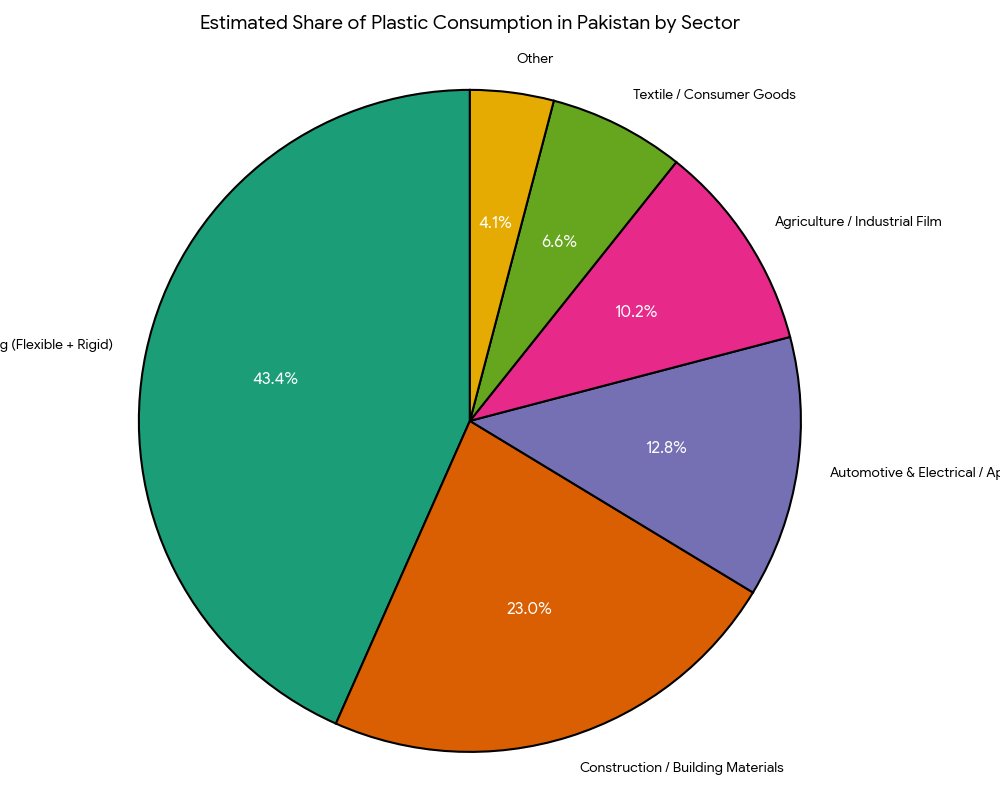
Estimated Sector-Wise Plastic Consumption (Modeling)
Using the limited data + sector trends + international benchmarks, here’s a modeled estimate (with assumptions) for how plastic consumption might be distributed across sectors in Pakistan in a recent year. This is not exact, but it can be useful internally or for proposals — and you should flag it as an estimate.
| Sector | Estimated Share of Plastic Consumption in Pakistan (%) |
|---|---|
| Packaging (Flexible + Rigid) | 40–45 % — Based on plastic industry structure, local production, and export data. |
| Construction / Building Materials (PVC, Pipes, Profiles) | 20–25 % — PVC use is heavy in construction; UNCTAD report supports large PVC use in this sector. UN Trade and Development (UNCTAD) |
| Automotive & Electrical / Appliances | ~10–15% — Plastics are used in vehicle interiors, wiring, lightweight parts, electronics, etc. (global trends + local growth). |
| Agriculture / Industrial Film | ~8–12% — Polyolefins (PE) used in films, sheets, stretch wrap. Polyolefin market data suggests strong use in film/sheet segments. pakistanbusinesstimes.com |
| Textile / Consumer Goods | ~5–8% — Synthetic fibers, packaging, plastic parts for textiles. |
| Other (Medical, Packaging Specialty, etc.) | ~3–5% — Includes specialty plastics, cutlery, small-scale industrial goods, etc. |
Interpretation & Caution
- These are estimates, not hard official statistics. Use them for planning, modeling, or internal reports — but not for regulation compliance without further validation.
- The actual distribution could be skewed by informal production, unregulated imports, or waste import flows, which are poorly tracked.
- Recycling and waste management trends will change these over time, especially if policies like Extended Producer Responsibility (EPR) are adopted more strongly.