
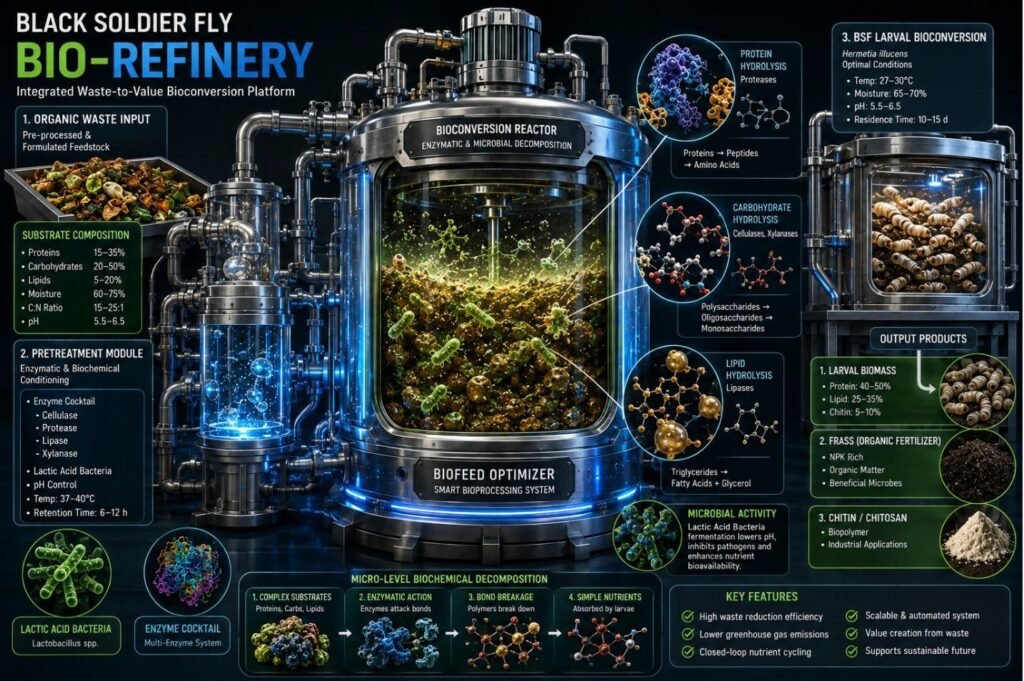
The Bio Feed Optimizer is an integrated BSF (Hermetia illucens) bioconversion system that converts organic waste into value-added products. Organic waste is first characterized and formulated according to protein, carbohydrates, lipids, moisture, C:N ratio, and pH. It then undergoes enzymatic and microbial pretreatment using cellulase, protease, lipase, xylanase, and Lactic Acid Bacteria to improve nutrient bioavailability. The optimized substrate is processed in a bioconversion reactor, where proteins, carbohydrates, and lipids are hydrolyzed into simpler nutrients and subsequently utilized by BSF larvae. The process produces three major outputs: larval biomass, nutrient-rich frass, and chitin/chitosan, establishing a circular waste-to-value bio-refinery system.
Organic Waste → Formulation → Pretreatment → BSF Bioconversion → Biomass + Frass + Chitin/Chitosan
Abstract
1. Introduction
2. Substrate Biochemical Dynamics
2.1 Macronutrient Stoichiometry
2.2 Protein, Carbohydrates, Lipids and Amino Acids
Protein provides amino acids required for tissue synthesis, enzymatic activity, cuticular development, and metabolic regulation, while carbohydrates primarily provide readily metabolizable carbon and energy. Food waste commonly contains readily degradable carbohydrates, whereas agro-industrial residues may contain greater quantities of structural carbohydrates and variable protein concentrations. Protein-rich residues can therefore complement carbohydrate-dominated substrates to achieve a more balanced formulation.
Lipids represent an energy-dense substrate component and are subsequently accumulated and metabolically transformed within larval biomass. Both lipid concentration and fatty-acid composition can influence the biochemical characteristics of the resulting larvae. Accordingly, substrate profiling should consider total lipid concentration, fatty-acid composition, saturated-to-unsaturated fatty-acid ratios, lipid oxidation, and potential lipid-associated contaminants.
The amino acid composition of the substrate also influences nitrogen assimilation and protein biosynthesis. Essential amino acids including lysine, methionine, threonine, valine, leucine, isoleucine, phenylalanine, histidine, and tryptophan should therefore be considered when evaluating feedstock quality.
2.3 Lignocellulosic Recalcitrance
Lignocellulose, consisting primarily of cellulose, hemicellulose, and lignin, represents a major biochemical limitation in agricultural residues. Its complex structure restricts enzymatic accessibility and consequently reduces nutrient availability. Although BSFL-associated microbial communities possess lignocellulose-degrading capabilities, pretreatment may increase accessibility and reduce the recalcitrance of the substrate matrix before larval feeding.
3. Physicochemical Characteristics
Moisture is a critical determinant of microbial activity, nutrient diffusion, substrate rheology, oxygen transfer, and larval feeding. TS represents the non-water fraction, while VS provides an approximate indicator of the organic fraction susceptible to degradation. Excessively wet substrates may develop anaerobic zones and poor structural integrity, whereas excessively dry
substrates can restrict microbial activity and nutrient accessibility. Thus, moisture optimization must be considered together with substrate composition and physical structure.
Rheological characteristics also influence substrate accessibility. Highly viscous substrates may restrict aeration and create anaerobic microenvironments, whereas coarse materials can reduce feeding accessibility. Particle size, bulk density, water activity, viscosity, porosity, and mixing homogeneity are therefore relevant process parameters. Mechanical size reduction can increase surface area and facilitate subsequent enzymatic hydrolysis and microbial colonization.
4. Enzymatic and Microbial Pretreatment
4.1 Enzymatic Hydrolysis
Exogenous enzymatic hydrolysis converts complex macromolecules into smaller and more accessible compounds. Cellulases hydrolyze cellulose toward cellobiose and glucose, while xylanases facilitate hemicellulose degradation. Proteases convert proteins into peptides and amino acids, whereas lipases can hydrolyze triglycerides into fatty acids and glycerol. These processes increase nutrient bioavailability prior to larval feeding.
The objective should be optimized substratum degradation kinetics rather than maximum hydrolysis. Excessive enzymatic treatment may increase processing costs without proportionally increasing larval conversion. Therefore, Bio Feed Optimizer should identify the minimum effective pretreatment intensity required to improve nutrient accessibility.
4.2 Solid-State Fermentation and Microbial Conditioning
Solid-state fermentation (SSF) provides a biological pretreatment strategy particularly relevant to agro-industrial residues. Microbial consortia can partially degrade structural polymers, produce extracellular enzymes, modify anti-nutritional compounds, and improve nutrient accessibility. Studies involving Lactobacillus, Aspergillus, and other microbial systems indicate that fermentation can enhance subsequent BSFL growth and substrate conversion.
5. BSFL Physiological and Metabolic Responses
BSFL bioconversion involves substantial interaction between the insect host and its associated microbiome. Gut microorganisms contribute to the degradation of proteins, lipids, polysaccharides, and cellulose, thereby facilitating nutrient liberation and influencing host metabolism. Dietary substrate can also alter gut microbial composition, demonstrating that substrate engineering may indirectly regulate larval microbial ecology.
BSFL-associated microorganisms may additionally participate in the transformation of selected xenobiotic compounds. However, xenobiotic transformation should not automatically be interpreted as complete detoxification because transformation products may retain biological activity or toxicity. Therefore, contaminant screening and product safety assessment remain essential.
Larval performance should be evaluated using multiple parameters, including Feed Conversion Ratio (FCR), Waste Reduction Efficiency (WRE), Substrate Conversion Efficiency (SCE), and Specific Growth Rate (SGR). Collectively, these indicators provide a multidimensional assessment of substrate bioconversion efficiency rather than relying solely on final larval biomass.
6. Bio Feed Formulation and Stoichiometric Optimization
The central concept of Bio Feed Optimizer is to convert substrate selection into a quantitative formulation problem. Multiple waste streams can be characterized according to carbon, nitrogen, protein, lipid, fiber, moisture, and volatile-solids content and subsequently blended under defined biochemical constraints.
The formulation process should optimize C:N ratio, protein-to-carbohydrate balance, moisture, pH, and fiber/lignin concentration while simultaneously considering processing cost and predicted conversion efficiency. Experimental BSFL trials are required to validate the resulting formulations. The optimal formulation is therefore not necessarily the substrate with the highest nutrient concentration, but the combination that maximizes nutrient accessibility, larval growth, substrate conversion, and product quality while minimizing processing and safety risks.
7. Frass and Downstream Valorization
BSFL bioconversion generates larval biomass and frass, with the latter containing residual organic matter, larval excreta, shed material, microorganisms, and mineral nutrients. Frass composition varies according to the feedstock and processing conditions; consequently, it should not be considered a chemically uniform fertilizer.
Frass quality assessment should include total and mineral nitrogen, ammonium, nitrate, available phosphorus, exchangeable potassium, C:N ratio, electrical conductivity, pH, and phytotoxicity. Although BSF frass can improve soil properties and plant nutrient availability, its agronomic application should remain dose- and substrate-specific to avoid nutrient imbalance or excessive electrical conductivity.
Chitin represents another potential value-added product. Insect exoskeletal material contains chitin, which can be recovered through processes involving demineralization, deproteinization, and decolorization. Subsequent conversion to chitosan and chitin-derived oligosaccharides can expand the biorefinery’s industrial applications
8. Research Gaps and Conclusion
A major research gap is the absence of a universally applicable biochemical formulation for heterogeneous organic waste. Substrate chemistry, microbial ecology, larval developmental stage, and environmental conditions interact to determine conversion performance. Further research should therefore integrate substrate characterization with microbiome analysis, metabolomics, and predictive modelling.
Overall, Bio Feed Optimizer provides a scientific framework for treating organic waste as a biochemically engineerable substrate. The proposed pathway integrates biochemical characterization, stoichiometric formulation, enzymatic and microbial pretreatment, optimized BSFL bioconversion, and downstream recovery of larval biomass and frass. This approach establishes a circular waste-valorization pathway:
Heterogeneous Organic Waste → Biochemical Characterization → Stoichiometric Formulation → Enzymatic/Microbial Pretreatment → BSFL Bioconversion → Insect Biomass + Frass + Chitin/Chitosan
The principal research requirement is to establish substrate-specific formulation windows and quantitatively correlate biochemical composition and pretreatment conditions with larval metabolic performance, substrate conversion efficiency, and product quality.