
From Food Waste to Clean Energy: Pakistan’s Organic Waste-to Biogas Revolution
By: Maryam Mazhar (Student of Superior University, Biochemistry Final Year)
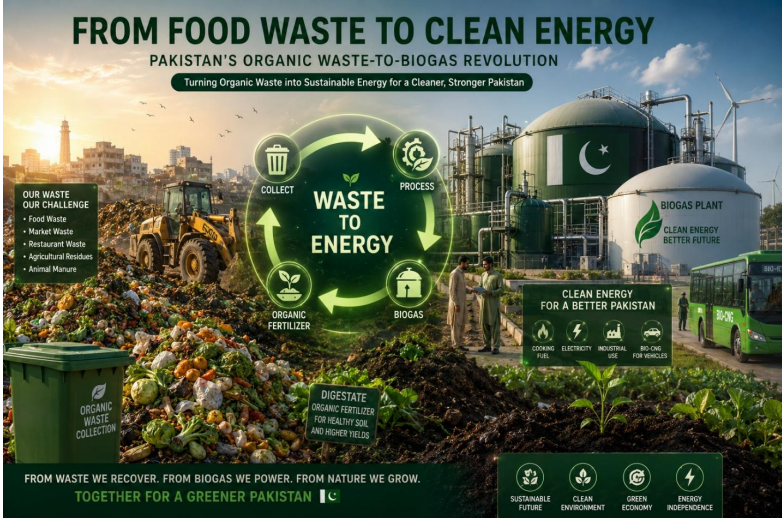
Pakistan’s transition from organic waste to renewable energy through a sustainable waste-to biogas system. Food waste, market waste, restaurant waste, agricultural residues, and animal manure are collected and processed through biological treatment. The organic material is converted into biogas for clean energy and digestate for agricultural use. The circular arrows represent a closed-loop resource recovery system, showing how waste can be transformed into energy, environmental benefits, and productive agricultural resources. The Pakistani landscape and
national elements emphasize that this solution is designed around Pakistan’s local waste, energy, and environmental challenges.
Pakistan’s Waste Problem Is Also an Energy Opportunity
Pakistan faces two challenges that are usually discussed separately: the growing volume of organic waste and the continuing pressure on energy resources. In reality, these problems are closely connected.
Every day, large quantities of food and agricultural residues are generated from homes, restaurants, vegetable and fruit markets, dairy farms, livestock operations, and food-processing activities. Much of this biodegradable material is mixed with other waste and ultimately dumped, burned, or left to decompose uncontrolled. At the same time, Pakistan continues to search for affordable and locally available energy solutions.
The question is no longer simply, “How can Pakistan dispose of its organic waste?”
The better question is:
“How can Pakistan recover energy from the organic resources it is already producing?”
One promising answer is optimized anaerobic digestion a biological process in which
microorganisms break down suitable organic matter in the absence of oxygen and generate biogas.
With appropriate treatment and purification, biogas can become a useful renewable energy source, while the remaining digestate can potentially be utilized as a nutrient-rich agricultural input. This is not just waste management. It is resource recovery
1. The Hidden Waste Stream Around Us
Consider a typical day in Pakistan. Fruit and vegetable markets discard damaged produce. Restaurants generate kitchen leftovers. Households throw away food scraps. Dairy farms produce animal manure. Agricultural activities generate crop residues. Individually, these materials appear insignificant. Collectively, they represent a substantial biological resource. The problem is that organic waste is rarely managed according to its composition. Wet food waste, dry residues, manure, plastics, metals, and packaging may all enter the same waste stream. Once organic waste becomes contaminated, biological recovery becomes more difficult and expensive. Therefore, the first technological intervention should be source segregation. Organic material should be separated before it becomes contaminated.
2. Packaging Reduction Must Come First
Biogas technology cannot compensate for poor waste practices upstream. A food-waste collection system containing plastic wrappers, disposable cutlery, multilayer packaging, glass, and metals creates serious operational problems for biological treatment. Pakistan therefore needs to address packaging waste before it reaches organic-waste processing facilities. Restaurants, markets, food manufacturers, and consumers can reduce unnecessary packaging by promoting reusable systems, refill models, bulk purchasing, recyclable materials, and responsible packaging design. The principle is simple: The cleaner the input, the better the recovery. Reducing packaging does not merely decrease plastic pollution. It also improves the quality and efficiency of downstream organic-waste recovery.
3. Optimizing Organic Waste for Biogas The real innovation is not simply building a digester. It is optimizing what goes into the digester. Different organic materials contain different proportions of carbohydrates, proteins, fats, fiber, moisture, and other components. Their digestion behavior can therefore vary considerably. A scientifically designed system can begin with:
Waste characterization → segregation → contamination removal → size reduction → moisture adjustment → feedstock mixing → anaerobic digestion → biogas monitoring → digestate recovery.
For example, instead of treating food waste, crop residues, and animal manure as identical materials, their properties can be analyzed and appropriate combinations tested. Parameters such as pH, temperature, moisture, organic loading, retention time, and feedstock composition can be monitored to improve microbial performance. This creates an important role for Pakistani biochemists, microbiologists, environmental scientists, and engineers. The objective is to transform an unpredictable waste stream into a controlled biological feedstock.
4. Beyond Conventional Recycling
When people hear “recycling,” they often think of plastic bottles, cardboard, or metal cans. But organic waste requires a different concept: biological recycling. Anaerobic digestion allows microorganisms to recover part of the chemical energy stored in organic matter. Instead of allowing waste to decompose uncontrolled, the process captures useful biogas. The remaining digestate can also be evaluated for agricultural use, subject to appropriate quality and safety assessment. Other biological technologies including composting, microbial treatment, fermentation, and nutrient recovery can complement anaerobic digestion. Pakistan should therefore move from a linear waste system toward a system in which materials continuously move between consumption, recovery, production, and reuse.
5. The Policy Gap:
From Collection to Recovery Pakistan has made progress in recognizing environmental and waste-management challenges, but implementation remains uneven. Waste systems differ significantly between cities, districts, and communities. A major weakness is that waste management is often evaluated according to how efficiently waste is collected and transported rather than how much material is actually recovered. This mindset needs to change. Future waste policies should encourage: • Source segregation of organic and recyclable waste
- Organic-waste diversion from uncontrolled dumping
- Standards for biological waste-treatment facilities
- Quality monitoring of recovered agricultural products
- Private-sector investment in resource recovery
- Local government and community participation
- Reliable data on waste generation and recovery
Technology for a Cleaner Pakistani Future
The future of waste management should combine biology with technology. Sensors can monitor temperature, pH, moisture, and gas production. Digital records can track the quantity and composition of incoming waste. Data analysis can identify which feedstock combinations perform best. In larger systems, automated monitoring and predictive models could help operators identify problems before they reduce biological efficiency.
Market/restaurant/farm → segregated organic waste → optimized feedstock → anaerobic digestion → biogas + digestate → energy/agriculture → reduced waste.
Such systems can be adapted to local conditions rather than depending entirely on imported models.
7. Changing the Pakistani Mindset
Technology will not solve the waste problem if people continue to believe that waste simply disappears after collection. It does not. When we throw food into a mixed bin, we are not ending its journey. We are transferring the environmental and economic cost somewhere else. A circular economy begins with a change in thinking.
Instead of asking:
Where should I throw This?
We should ask
What resources is still present in this material?
This mindset can begin in households, markets, restaurants, farms, schools, and workplaces. Young people can become the strongest drivers of this cultural change because they are not only waste generators; they are future scientists, entrepreneurs, policymakers, engineers, and business leaders.
8. My Vision as a Young Pakistani Changemaker
As a student and young Pakistani, I do not want to see our country’s waste problem discussed only as an environmental burden. I see it as an innovation challenge. Our markets produce organic waste. Our farms produce biomass. Our restaurants produce food residues. Our households produce biodegradable waste. These resources should not automatically become landfill material. I envision a Pakistan where waste-management companies are not merely collectors, but resourcerecovery companies; where markets separate their organic waste because it has economic value; where farms can generate renewable energy from biological residues; and where young researchers develop locally appropriate technologies instead of waiting for solutions from elsewhere. The transition will not happen overnight. It requires investment, regulation, research, infrastructure, and behavioral change. But every successful system begins with one change in perspective.
Conclusion:
Waste Should Become Part of the Solution Pakistan’s organic-waste challenge is not only a problem of cleanliness. It is connected to energy, agriculture, climate, public health, resource efficiency, and economic development. Optimizing organic feedstocks for anaerobic digestion offers one pathway to address these challenges simultaneously. Reducing packaging keeps biological inputs cleaner. Segregation makes recovery possible. Biotechnology converts organic matter into useful outputs. Smart monitoring improves efficiency. Strong policy enables scaling. And behavioral change makes the entire system sustainable. The goal should not be to build a society that simply produces less waste. The goal should be to build a society where waste has a second purpose. Pakistan’s future will be cleaner when we stop treating organic waste as something to be hidden and start treating it as a resource waiting to be recovered. As young innovators, our responsibility is not merely to inherit Pakistan’s environmental challenges. It is to redesign what comes next.
Had fun reading this article? Share it and support the author
Zero Waste Solutions Share Now